
Same model. Same prompt.
One of them has taste.
A model with no felt preference cannot prefer. Asked for a landing page, it returns the average of every landing page it has seen — and that average is what you call slop. claudetaste gives Claude an emotion to hold, then makes every decision answer to it.
Instant repo access · Works with any Claude Code project
The only difference is the skill.
Reached for a gradient hero, three stock-photo cards and a fake stats band. Competent. Anonymous. You have seen this page a hundred times.
Chose a feeling first — golden hour in a barn — then built to it. Custom palette, paired typefaces, a card deck you can actually drag. It committed to something.
One command. No config.
Pay once and your GitHub account is added to the private repo. From then on the skill is one npx away, in any project, on any machine you are signed in on.
Slop is not a style problem. It is a missing emotion.
A model with no felt preference cannot prefer, so it hedges toward the mean of its training data, and the mean is a purple gradient. claudetaste installs the missing part.
-
01
The emotion becomes the brief
Before layout, before a color, Claude resolves your subject into an affective target across three senses at minimum, and states the strategic reason that feeling serves the page's job. Every later decision has to trace back to it: feeling, implication, spec. Not a rule it obeys. A conclusion it reached, which is why it holds for eight sections instead of two.
-
02
Then it studies what already produces it
Humans solved this centuries ago and are still solving it. The skill ships expertly crafted design work from products you use every day, indexed by the feeling it produces, so Claude reads the mechanism behind the sensation rather than guessing at what expensive looks like. It borrows the move, never the pixels.
-
03
Boldness is a budget, not a mood
Berlyne showed preference peaks at moderate arousal: bland fails on one side, chaos on the other. So the page runs an actual ledger. Density, color, motion and asymmetry are spends. Whitespace and stillness are refunds. Every big spend has a payer, and the one memorable thing is the planned spike everything else pays for.
“It is not copying a bad designer. It is averaging a thousand good ones.”
The mean of every landing page ever made is a page nobody chose, that nobody remembers, and that converts like nobody built it.
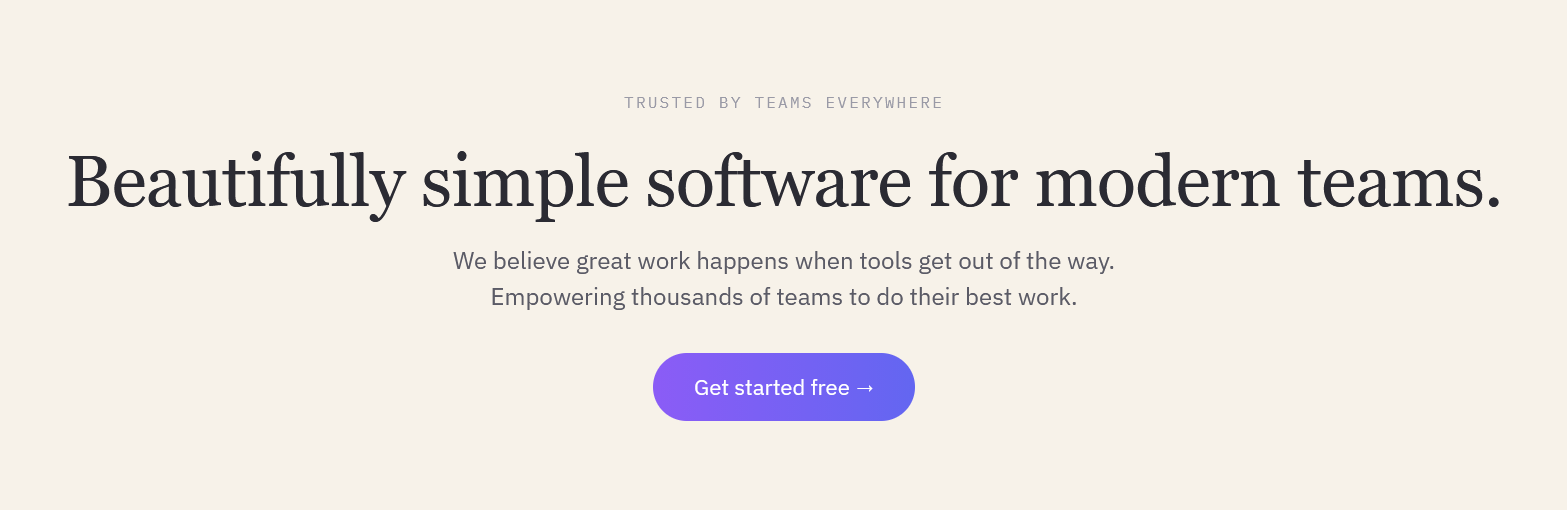
- Purple gradient CTA
- High-contrast serif
- Letterspaced eyebrow
- Sounds cool, says nothing
- Every website looks the same
Frequently asked questions
Is your question not answered here? Send an email to contact@tastecompany.co, all your questions will be answered.
How is this different than Claude's pre-existing frontend-design skill?
Prohibition-style “taste” skills like frontend-design try to improve output by banning bad patterns: removing options doesn’t create judgment, it just pushes the model to the next most average choice. You burn tokens on rules, and the result still drifts back to the mean.
claudetaste does not hand Claude a checklist of things not to do. It installs the missing faculty: an affective target derived from your subject, a WHY chain binding every downstream decision to it, a corpus of expertly crafted design work from products you use every day so it can study the mechanism behind a sensation instead of recalling its surface, and an “arousal ledger” that keeps the result off both the bland and the chaotic ends of the curve.
Which presented feeling should I pick?
claudetaste will sometimes generate 3-5 candidate feelings and ask the user which one to pick. This:
A) Increases randomness, further creating unique designs
B) Lets Claude have a better understanding of the project
claudetaste will always recommend one option, which will be marked with a star. Go with your gut, if unsure, pick the option it recommends.
How can I optimize my prompts for claudetaste?
Use vibe-words like Apple-y, Linear-like, warm like Claude. If you have a feeling in mind, like "coffee-shop warmth", mention it. Give Claude as much context as possible so it fully understands your project.
It installed — now where is it?
The skill lands in ~/.claude/skills/claudetaste, which makes it available to every project rather than just the one you ran the command in.
Restart Claude Code so it picks up the new skill, then call it by name:
/claudetaste build me a pricing pageRe-run the same npx command any time to pull the latest version over the top.
Alternative command?
You can also use this to install the skill. Try it if the initial command fails.
npx github:tastecompany/claudetaste“npx: command not found”
Node isn't installed. npx ships with npm, which ships with Node — install Node 18 or newer from nodejs.org and you'll have all three.
Then confirm it worked:
node -v # v18.0.0 or higher npx -vOn macOS with Homebrew: brew install node. On Windows, use the installer from nodejs.org and reopen your terminal afterwards — the PATH only updates in new windows.
“git: command not found”, or npx hangs at “Cloning…”
Installing from a GitHub repo makes npx shell out to Git, so Git has to exist separately from Node. Get it from git-scm.com.
git --versionmacOS also installs it via xcode-select --install. On Linux: sudo apt install git or your distro's equivalent.
“Repository not found” or a 404
A private repo returns 404 rather than 403 when Git can't prove who you are — so this is almost always an access problem, not a typo.
Two things to check. First, that you accepted the invite: it arrives by email right after checkout and also sits at github.com/tastecompany/claudetaste/invitations. Second, that the GitHub account you connected at checkout is the same one your terminal is authenticated as.
gh auth status # which account am I?Buy once. Use forever.
No need to hack your way through slop with “make no mistakes”. Costs less than a shirt.
- The full thinking framework, built on forty years of affective science
- Expertly crafted designs from the websites you use every day, indexed by feeling
- A stock-image fetcher, so pages ship with real photography instead of gradient blobs
- One npx command, any project, every future update included
Secure checkout by Polar. Repo access lands on your GitHub account.